No matter what you do, someone will judge you for it.
You may be in a car - driving too slow, too fast, or just too normal. You may drive a nice car or an ugly one, a white one or a green one.
You may have kids or you may not. You may be Christian or Muslim, Croatian or some other nationality, black or white. You may be depressed or happy, a saint or a sinner.
You may be out there helping your community, or keeping to yourself. You may be a blood donor or not. You may be X or Y - or you may not be any label at all.
Someone will still find a reason. Your neighbour. Your relative. A stranger on the street. A coworker, your boss, a client, a teacher. An old friend, an in-law, a competitor. The driver behind you, the driver in front of you. A landlord, a tenant, a nurse, a doctor, a politician - or some random person on the internet who never met you.
Fifty percent, give or take
Half the people will have something against you. Maybe not exactly fifty percent - but a lot of them do. Humans are imperfect, jealous, envious, different. It may be your neighbour. It may be someone you will never see again.
That is just how the world works. You cannot do much about that.
What I can control
What I can control is what I do to other people - accidentally or on purpose. I try to follow the golden rule in ethics:
That is a standard I can actually hold myself to. I cannot control what strangers think about my car, my faith, or my mood. I can control whether I pile on - or remember that pleasing everyone is a trap.
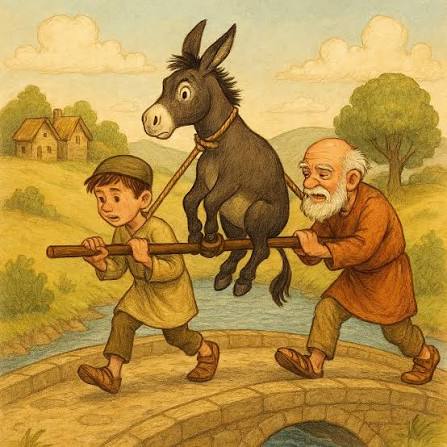
The man, the boy, and the donkey
An old Aesop fable makes this painfully clear: The Man, the Boy, and the Donkey (Aarne-Thompson-Uther type 1215). The version below follows Joseph Jacobs, via D. L. Ashliman's folktale collection at the University of Pittsburgh.
The setup
A man and his son were going to market with their donkey, the boy walking alongside while the father led the animal on foot.
First critic
A countryman passed them: “You fools, what is a donkey for but to ride upon?” The man put the boy on the donkey and they went on.
Second critic
They passed a group of men. One said: “See that lazy youngster - he lets his father walk while he rides.” The man ordered the boy down and got on himself.
Third critic
Two women passed: “Shame on that lazy lout to let his poor little son trudge along.” At last the man took his boy up before him on the donkey, and both rode.
Fourth critic
In town, passersby jeered. “Aren't you ashamed - overloading that poor donkey, you and your hulking son?” Man and boy got off and tried to think what to do.
The absurd end
They cut a pole, tied the donkey's feet to it, and carried the animal on their shoulders. Everyone who met them laughed. At a bridge the donkey kicked free, the boy dropped his end of the pole, and in the struggle the donkey fell into the water and was drowned.
Try to please everyone, and you will please no one.
An impossible mission
The pattern repeats in ordinary life. Too serious or not serious enough. Too modest or too wasteful. Too early or too late. If you forgive, you are weak; if you push back, you should have forgiven.
Trying to win everyone's approval is an impossible mission. You will always be someone's target. The donkey fable is comic because the father keeps obeying every critic until the solution becomes absurd.
The point is not to stop caring about people. It is to stop rearranging your life around every voice in the crowd.
Hold the golden rule. Let the rest go. Get used to it.